
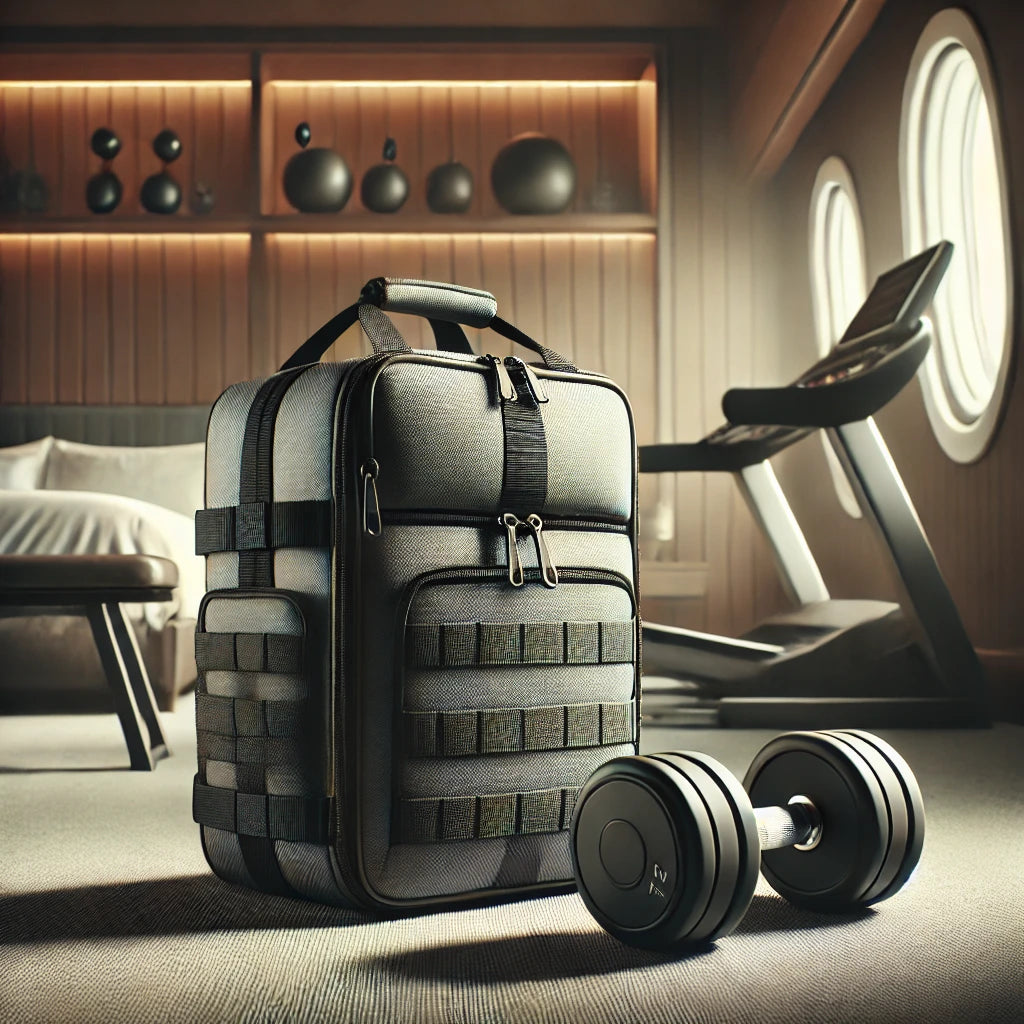
For a road warrior, the weakest link in a travel fitness routine is rarely motivation. It is the bag. A standard gym bag is built for a towel, a water bottle and a pair of shoes. Put two dumbbells in it, carry it through a terminal and toss it into a rental car, and the handles start to pull away from the seams by the second trip.
Pilots, flight attendants, travel nurses and consultants who keep training on the road learn this fast. The right bag protects your weights, your luggage and your back, and it makes the decision to train on a layover automatic instead of a negotiation. This guide breaks down the five bag designs that hold up to travel with dumbbells, the build details that separate a durable bag from a disposable one, and how to pack and care for a loaded bag so it lasts.

Why Traveling with Dumbbells Is Worth the Effort
Hotel gyms are a gamble. Some have a full dumbbell rack. Many stop at a treadmill, a cable machine and a pair of light hex dumbbells. When your schedule puts you in a different city every few days, bringing your own weights is the only way to guarantee the same session every time.
Consistency is the point. The CDC recommends muscle-strengthening activity on two or more days a week for adults, on top of 150 minutes of moderate aerobic activity. Two short strength sessions a week are easy to plan at home and easy to lose on the road. Your own dumbbells, in a bag you trust, remove the excuse.
The 5 Durable Bag Types That Survive Travel With Dumbbells
There is no single best bag for everyone. The right choice depends on how much weight you carry, how far you walk with it, and whether it rides in the cabin, the hold or a car trunk. These five designs cover nearly every road-warrior setup. Judge any specific bag against the build points below rather than the label on the tag.
1. The Padded Duffel With a Reinforced Base
Best for: a pair of fixed dumbbells or an adjustable set in a checked bag or the trunk of a rental car.
A duffel is the simplest shape for weights: one wide compartment that lets the load sit flat instead of rolling. What separates a travel-grade duffel from a gym bag is the floor. Look for a stiffened or double-layer base panel and handles stitched through to that base, not just to the side fabric. Weight pulls hardest where the handles meet the bag, so box-and-X stitching or bar-tacks at those points matter more than any marketing claim.
Inside, a padded divider or a removable foam pad keeps steel from grinding against your shoes and chargers. If the bag has no padding, wrap each dumbbell in a towel and lay them along the floor, end to end. Once you are past about 20 pounds, carry it by both handles rather than the shoulder strap; a single strap loads one seam and one shoulder.
2. The Backpack-Style Weight Carrier
Best for: lighter loads you walk with, from terminal connections to a hotel shuttle or a walk to the park.
A backpack spreads weight across both shoulders and keeps your hands free for a boarding pass and a coffee. The trade-off is depth: weights sit low and press against your lower back, so a padded back panel and a sternum strap are not optional. A bottom compartment that opens separately lets you load the dumbbells at the base, closest to your spine, which is where heavy items belong.
Keep backpack loads modest. Coated fixed weights in the 5- to 15-pound range are realistic; a full adjustable set usually is not. If the pack sags at the zippers, you have outgrown it.
3. The Rolling Duffel or Wheeled Carry-On
Best for: heavier adjustable sets and long terminal walks.
Wheels take the weight off your body entirely, which is why a rolling bag is the default for anyone traveling with more than one set of plates. Check two things before trusting one with steel: the wheel housings should be bolted or riveted to a rigid frame, and the telescoping handle should not flex when the bag is tipped back fully loaded.
Put the dumbbells at the wheel end so the bag tips onto its wheels cleanly and does not fall forward when you let go of the handle. If you plan to carry it on, confirm your airline's size limit for the bag itself; dimensions are the rule most carry-ons get stopped for.
4. The Compression Pouch Inside Your Suitcase
Best for: travelers who refuse to add a second bag.
You do not always need a dedicated bag. A padded tool pouch, a thick packing cube or a compression sack turns your existing suitcase into a weight carrier. The pouch keeps the dumbbells in one block, stops them migrating to one end during baggage handling, and protects your clothes from grip residue.
Pack the pouch flat against the suitcase wall closest to the wheels, then build clothing around it. This is the lightest way to travel with weights because the only added material is the pouch itself, which matters when every pound counts against an airline allowance.
5. The Sling or Tote for Light Fixed Weights
Best for: wrist weights, a single light dumbbell, or resistance bands paired with one weight.
A structured tote or crossbody sling works when the load is small and you want it at the hotel gym, the pool deck or a client site without a full duffel. Choose one with a flat bottom and a zip top so a weight cannot roll out when the bag tips over in an overhead bin or on a car seat.
This is also the bag that keeps a routine consistent when the hotel gym already has a rack: carry your bands, a jump rope and one light weight for warm-ups, and use the hotel's heavier dumbbells for the main sets.
How to Judge Durability Before You Buy
Labels like heavy-duty and military-grade tell you nothing on their own. Turn the bag over and check these five points instead.
- Stitching at stress points. Handles, strap anchors and the corners of the base should have bar-tacks or box-and-X stitching. A single straight seam will fail first.
- Zipper size. A heavier-gauge zipper on the main compartment survives an overstuffed load. Small coil zippers split when weights shift against them.
- Base construction. Press on the floor of the empty bag. If it folds easily, the weights will too, and the bag will sag into a U-shape when you lift it.
- Weight rating. If the maker lists a maximum load, treat it as a hard ceiling. Exceeding it is how handles tear out mid-terminal.
- Cleanable lining. Weights pick up grip residue and sweat. A wipe-clean lining keeps that off the rest of your kit.
How to Pack Dumbbells Efficiently for Travel

Pad both directions
Padding protects the weights from the bag and the rest of your luggage from the weights. Wrap each dumbbell in a towel, a sweatshirt or a packing cube. Neoprene-coated weights still benefit from a layer; the coating scuffs and the steel core underneath is what dents a laptop.
Keep the load low and centered
Weights go on the bottom, in the middle, with lighter items built up around them. A centered load carries straighter and keeps a rolling bag from tipping. If you carry a pair, place them side by side rather than at opposite ends; split weight makes a duffel twist in your hand.
Pack in layers
Build the bag like a stack: weights and shoes at the base, folded training kit in the middle, soft items and a toiletry pouch on top. Layers stop the load from shifting and let you pull out tomorrow's kit without unpacking the steel.
Know what screening and your airline allow
Security screening and baggage limits are separate questions. Before you fly, search the TSA What Can I Bring? tool; for anything it does not list, TSA points travelers to AskTSA. Canada's screening authority lists dumbbells and other fitness weights as permitted in both carry-on and checked bags, and tells travelers to contact their airline about size, weight and quantity limits. Your airline, not the checkpoint, sets those limits, and they vary by carrier and fare. Weigh the packed bag at home so the scale at the counter holds no surprises.
Caring for a Loaded Bag on the Road
- Air it out. Open the bag in the hotel room after each session so sweat and residue do not sit in the lining.
- Wipe it down weekly. Most nylon and polyester shells clean with a damp cloth and mild soap; check the care label first.
- Inspect the stress points. Before each trip, look at the handle anchors, strap rings and zipper ends. Loose stitching is a one-trip warning.
- Store it empty and dry. Leaving weights in a bag between trips stretches the base and holds moisture against the fabric.
A 25-Minute Dumbbell Session for the Hotel Room
A good bag earns its space when the session happens. This circuit needs one pair of dumbbells and the floor between the bed and the desk.
- Goblet squat — 3 sets of 10 to 12
- Single-arm row (braced on the bed or a chair) — 3 sets of 10 per side
- Floor press — 3 sets of 10 to 12
- Reverse lunge — 3 sets of 8 per leg
- Standing shoulder press — 3 sets of 10
- Dead bug or plank — 3 rounds of 30 to 45 seconds
Move through the list once, rest 60 to 90 seconds, and repeat for three rounds. Start with a 5-minute warm-up of marching, arm circles and bodyweight squats, and finish with a few minutes of stretching. Choose a weight you can lift with clean form for every rep.
Frequently Asked Questions
Can I bring dumbbells on a plane?
Check the TSA What Can I Bring? tool before you fly and ask AskTSA about anything it does not list. Canada's screening authority permits fitness weights in carry-on and checked bags. Either way, your airline's size and weight limits apply, so confirm them for your carrier and fare.
What weight should I travel with?
Bring the lightest set that still challenges your main lifts. For most travelers, one adjustable pair or two fixed pairs covers a full-body routine. If a hotel gym has a rack, carry only bands and one light weight for warm-ups.
Duffel or rolling bag?
If you walk long distances with the weights, choose wheels. If the bag mostly moves from car trunk to hotel room, a reinforced duffel is lighter and simpler.
Pack lighter. Travel further.
The weights take up enough of your bag. Your training kit should not. Dumbbells & Hotels builds a layover-ready capsule wardrobe designed by pilots for the hotel gym, so one bag covers the flight, the session and the client dinner:
- Wheels Up, Weights Down Travel Workout Hoodie — the layer for the early lobby call and the cool-down walk.
- Travel Strong Unisex Travel Fitness Tee — the capsule-wardrobe tee that earns its bin space.
- Carry-On Only. Excuses Left Behind. Women's Flowy Racerback Tank — for the traveler who packs one bag and still trains.
Shop the gear designed by pilots for the hotel gym. Stay Fit. Stay Stylish. Stay Motivated.
Keep reading
- How to Pack Dumbbells in Your Travel Bag
- Why You Need a Specialized Bag for Dumbbells
- Stay Fit on the Road: Essential 30-Minute Workouts for Hotel Gyms
Sources
- What Can I Bring? — Transportation Security Administration
- Weights (such as dumbbells or other fitness & aerobic weights) — Canadian Air Transport Security Authority
- Adult Activity: An Overview — Centers for Disease Control and Prevention


